
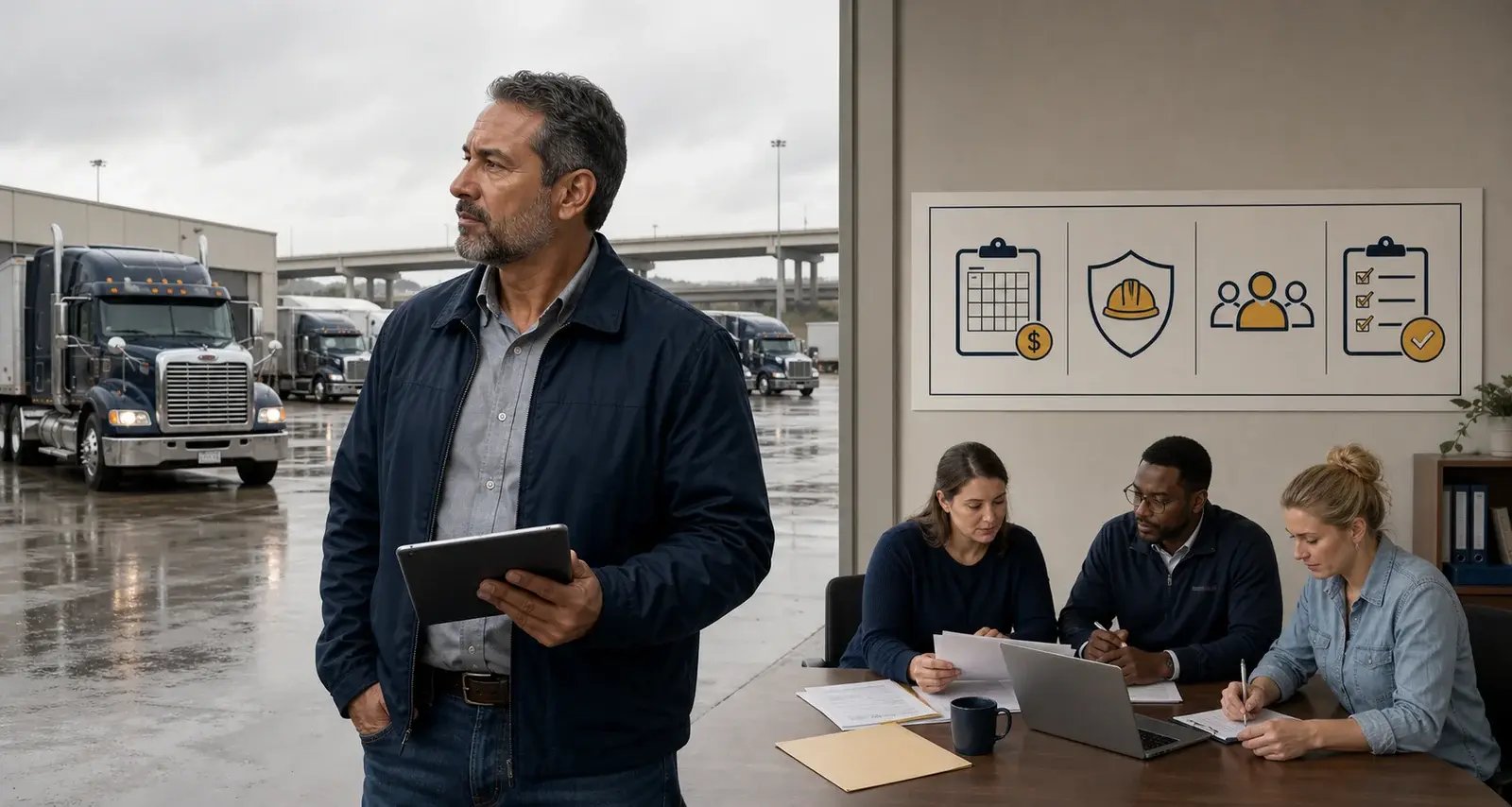

You've probably heard the term "PEO" somewhere, from another trucking company owner, on a form, in passing conversation at an industry event. What you might not know is what it actually means, or why it comes up so often among businesses that run drivers, handle payroll, and carry workers' comp.
What a PEO Actually Is
A Professional Employer Organization, or PEO, becomes what's called a co-employer alongside your business. That sounds bigger than it is in practice. It means the PEO takes on specific legal and administrative responsibilities, issuing W-2s, filing employment taxes, carrying workers' compensation coverage, while your business keeps running exactly as it does now. You still own the trucks, run the routes, and manage your drivers. The PEO just takes on the paperwork behind them.
Co-employment is the one thing that actually separates a PEO from a staffing agency or a payroll vendor. You're not handing your business over to anyone, you're splitting specific responsibilities with a provider built to handle them.
What It Handles, and What Stays With You
Once a business is paired with a PEO, the provider typically takes on payroll processing, workers' compensation coverage and the claims that follow an injury, health and other benefits administration, and HR compliance, the kind of regulatory detail that changes yearly and is easy to miss when you're also running a fleet.
Hiring, firing, scheduling, day-to-day supervision, and the direction of your business stay entirely in your hands. A PEO doesn't manage your drivers or make decisions about how you run your operation. It takes the administrative weight off your plate so you can focus on the parts of the business only you can run.
Why Businesses Make the Switch
According to the National Association of Professional Employer Organizations, businesses that use a PEO see 12 percent less employee turnover and are 50 percent less likely to close compared to businesses that don't. That's not a marketing claim, it's an industry association tracking outcomes across thousands of businesses.
The reasons are practical. Access to benefits and insurance pricing usually reserved for much larger companies. Fewer compliance mistakes in an industry where the rules change constantly. And time back, since the administrative work that used to eat into a week gets handled by people who do it full time.
Most businesses using a PEO have between 10 and 150 employees, but that's shifting. Roughly a third of PEO clients today have fewer than 10 employees. If you've wondered whether your fleet is too small for this to make sense, the honest answer is probably not anymore.
Where We Fit In
To be clear about our own role: SE Davis isn't a PEO, and we're not an insurance provider. What we do is review your current setup, cost, risk, workers' comp, payroll, and figure out whether a PEO or similar arrangement would actually help your specific business. If it wouldn't, we'll tell you that directly. If it would, we handle the legwork of finding the right provider and comparing real options against what you have now.
If you're curious whether this applies to your business, a review costs nothing and doesn't commit you to anything. Request a Review